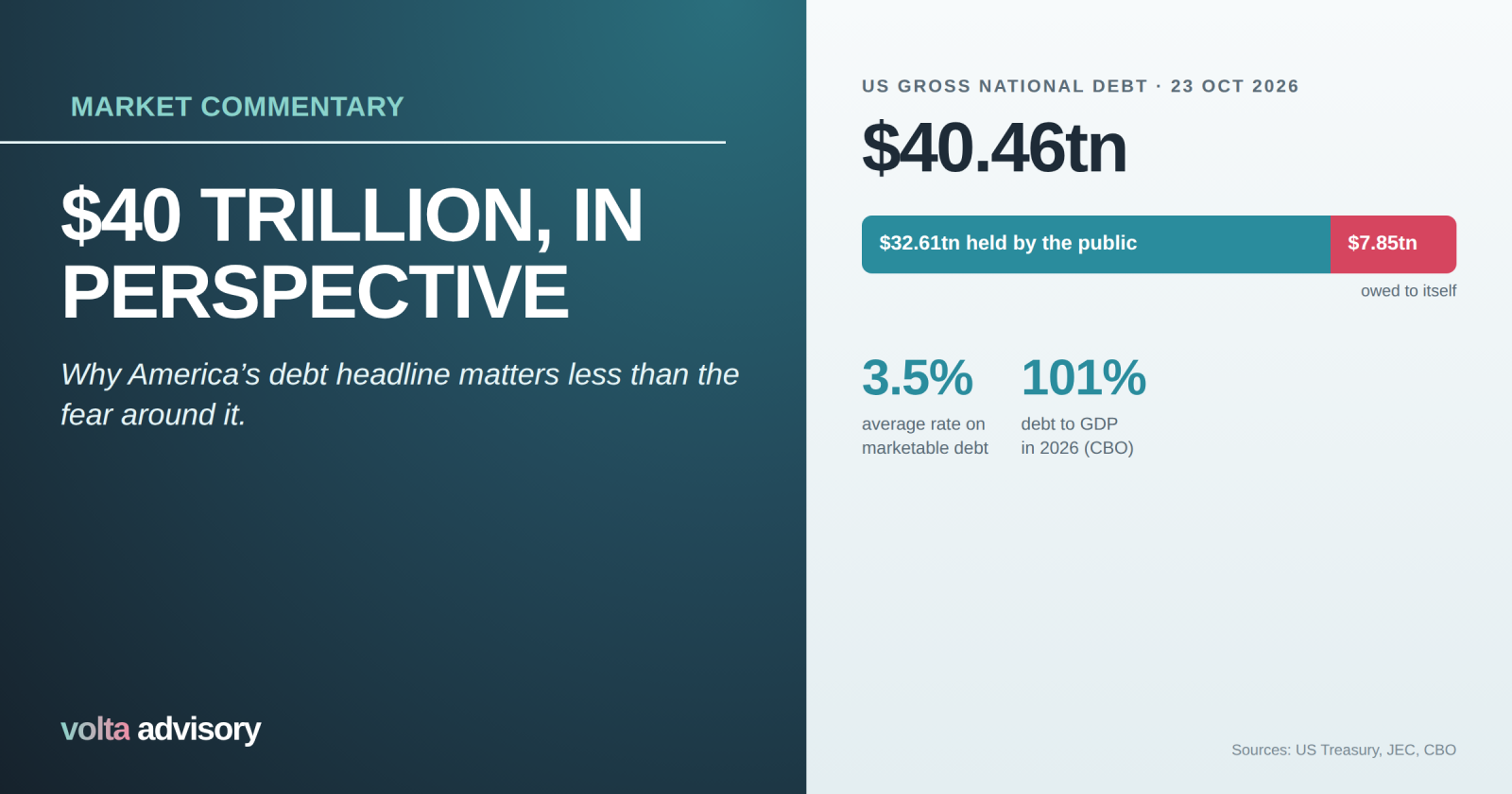
US national debt passed $40 trillion in August 2026 and now stands above $40.4 trillion. Headlines call it a “debt bomb”. The number is real, but on its own, it says little about what happens next.
Not all of it is owed to markets
Of the total, about $7.85 trillion is owed by the US government to its own agencies, such as trust funds. The debt held by the public, the part that markets actually finance, is about $32.6 trillion.
The cost matters more than the size
The average interest rate on US marketable debt was about 3.5% in September 2026. Much of the debt was locked in at lower rates, so higher market rates feed through only gradually. That is not to say the bill is small: interest costs now exceed $1 trillion a year, and that is the figure worth watching.
Currency matters most
The United States borrows in its own currency, which is also the world’s main reserve currency, in the deepest bond market in the world. That is a very different position from a country borrowing in a foreign currency it cannot print. High debt is a constraint, not a countdown.
What to watch instead
Rather than the headline total, watch interest costs as a share of the budget, demand at Treasury auctions, and the path of US rates. The Congressional Budget Office expects debt to rise from about 101% of GDP in 2026 to 120% in 2036: a slow trend, not a cliff.
Volta’s view
For businesses in Africa, the US debt total matters mainly through one channel: the cost of dollars. If heavy borrowing keeps US rates higher, dollar funding, trade lines and dollar-denominated debt stay expensive. Lock in terms early, and consider structures and currencies that reduce that exposure.
Sources: US Treasury, Debt to the Penny; Joint Economic Committee; Congressional Budget Office. Volta Advisory provides general information only, not investment advice.